Engine Monitoring
Kavlico Sensors
6-Cylinder Fuel Injected
Lycoming & Continental
The EMSKIT-L6F is a complete, pre-configured engine monitoring sensor kit built specifically for fuel-injected 6-cylinder Lycoming and Continental engines — the powerplants found in Beechcraft Bonanza, Cessna 210, Piper Comanche, Cirrus SR22, and similar high-performance general aviation aircraft. Instead of sourcing probes from multiple vendors, this kit delivers every sensor in a single, compatibility-verified bundle using Kavlico precision sensors — the industry standard for avionics-grade measurement.
What's included
The EMSKIT-L6F ships as a complete, matched sensor set. All probes are factory-calibrated and pre-terminated to plug directly into compatible EMS data acquisition units.
| Component | Type & spec | Purpose |
|---|
| 6× EGT probes | Type K thermocouple, injector boss sizing | Exhaust gas temperature per cylinder |
| 6× CHT probes | Bayonet or ring style, matched to engine | Cylinder head temperature per cylinder |
| Oil temperature sender | Kavlico precision, threaded | Engine oil temp monitoring |
| Oil pressure transducer | Kavlico, rated to engine PSI range | Oil pressure (PSI) monitoring |
| Fuel pressure transducer | Injected-rated (14–45 PSI typical) | Fuel delivery confirmation |
| MAP sensor | Manifold absolute pressure | Manifold pressure for power management |
| Wiring harness | Pre-terminated, labeled | Direct plug-in to EMS module |
Note: Exact probe types (bayonet vs. ring CHT) vary by engine model. Confirm your specific Lycoming IO- or Continental IO-series variant before ordering to ensure correct probe sizing.
Compatible EMS display systems
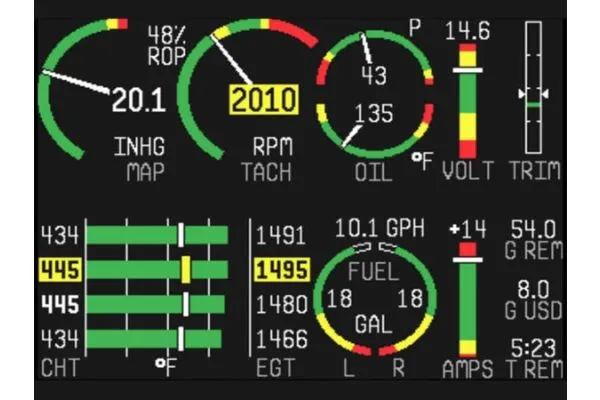
The EMSKIT-L6F is engineered to integrate with leading experimental and certified avionics platforms:
7" touchscreen EFIS/EMS. Ideal for smaller panels. Same module requirement as HDX1100.
Garmin G3X Touch
Via GEA 24 engine/airframe unit. Full 6-cylinder primary EMS support.
Glass panel, 6-cylinder TSO version. Certified and experimental aircraft.
Full-featured primary EDM. Logs all parameters with download capability.
Advanced primary EMS with fuel flow, fuel management, and 4-tank support.
Builder tip: Pairing the EMSKIT-L6F with the SkyView HDX1100 and SkyView ADAHRS-200 gives you a fully integrated EFIS+EMS cockpit without a separate engine instrument panel.
Why Kavlico sensors
Kavlico (now part of Sensata Technologies) has supplied precision sensors to aerospace, defence, and general aviation OEMs for over five decades. Their probes are specified in installation manuals from Dynon, Garmin, and Electronics International because of three core properties:
Calibration accuracy
±1% full-scale
Vibration rating
MIL-spec tested
Temperature range (EGT)
Up to 2,200°F
Signal type
Type K thermocouple
Repeatability
Consistent across service life
Cross-reference
Listed in major avionics IMs
This matters because inconsistent sensor readings — even fractionally off — can cause pilots to misread engine health, lean the mixture incorrectly, or miss early signs of cylinder detonation. Kavlico's precision eliminates that uncertainty.
Fuel injected vs. carbureted: why kit selection matters
A fuel-injected Lycoming IO-360, IO-540, or Continental IO-470/IO-520 operates at fundamentally different fuel system pressures than a carbureted engine:
| Parameter | Fuel injected (IO-series) | Carbureted (O-series) |
|---|
| Fuel pressure range | 14–45 PSI (typical) | 0.5–5 PSI (low pressure) |
| Fuel system type | Individual injector lines to each cylinder | Float bowl → carburetor → intake |
| Mixture control | Vernier or servo-controlled | Mixture cable to carb |
| Fuel pressure sensor needed | Yes — high-pressure rated | Optional / low-pressure |
Common installation error: Installing a carbureted fuel pressure sensor on a fuel-injected engine is one of the most frequent EMS setup mistakes. The EMSKIT-L6F includes the correct high-pressure transducer rated for injected systems — eliminating this risk entirely.
Installation guidance
This kit is intended for installation by an FAA-certificated A&P mechanic for certified aircraft. For experimental and amateur-built aircraft under FAR Part 21.191, the builder/owner may install it themselves.
1
Identify and label all six ports. Locate exhaust boss positions and CHT ports on each cylinder. Number them 1–6 per your engine manufacturer's firing-order convention (typically 1-3-5 left bank, 2-4-6 right bank for Continental; 1-3-5-7 for 6-cyl Lycoming).
2
Install EGT probes. Thread each type K probe into the exhaust boss. Torque to engine manufacturer specification — typically 50–70 in-lbs for type-K probes. Do not overtorque; boss threads are easily damaged.
3
Install CHT probes. Seat bayonet probes firmly in the head bosses. For ring-style probes, install under the appropriate spark plug per the EMS installation manual.
4
Install oil and fuel sensors. Thread the oil temp and oil pressure sensors into the engine accessory case ports. Install the fuel pressure transducer at the fuel manifold. Verify torque and safety-wire as required.
5
Route and secure wiring. Route harness away from exhaust, control cables, and moving parts. Secure with Adel clamps at minimum 12-inch intervals per
FAA AC 43.13-1B.
6
Connect to EMS module and configure. Plug harness into your EMS data acquisition unit. Configure alarm limits to your engine's red-line values in the EMS software.
7
Ground run verification. Perform a full-power ground run and verify all six EGT and CHT channels read within expected limits. Investigate any channel reading more than 50°F different from its siblings.
Common aircraft compatibility
The EMSKIT-L6F is appropriate for any aircraft equipped with a fuel-injected 6-cylinder Lycoming or Continental engine. Common examples:
| Aircraft | Engine | Notes |
|---|
| Beechcraft A36 Bonanza | Continental IO-550-B | 6-cyl, fuel injected — direct fit |
| Cessna 210 (later models) | Continental IO-520 / IO-550 | 6-cyl, fuel injected — direct fit |
| Piper PA-32R Arrow IV / Lance | Lycoming IO-540 | 6-cyl, fuel injected — direct fit |
| Cirrus SR22 | Continental IO-550-N | 6-cyl, fuel injected — direct fit |
| Mooney M20M Bravo | Lycoming TIO-540 | Turbocharged 6-cyl — confirm probe boss sizing |
| Experimental builds (RV-10, etc.) | IO-540 or IO-550 variants | Ideal for EAA builders |
Always cross-reference your aircraft's Parts Catalog (IPC) and maintenance manual to confirm the exact probe sizes and port types for your specific engine serial number range.
Regulatory and standards reference
The following FAA and industry documents govern EMS installation for both certified and experimental aircraft:
Frequently asked questions
Will this kit work with my Lycoming IO-360 (4-cylinder)?
No — the EMSKIT-L6F is configured for 6-cylinder engines. For 4-cylinder Lycoming and Continental fuel-injected engines, see the
EMSKIT-L4F. It uses the same Kavlico sensor quality with a 4-channel EGT/CHT configuration.
Do I need an A&P to install this in my experimental aircraft?
For experimental amateur-built aircraft operating under FAR Part 21.191(g), the builder/owner is permitted to perform their own maintenance and modification, including EMS installation. For certified aircraft, an FAA-certificated A&P mechanic must perform the work, and an IA (Inspection Authorization) is required to approve the return to service.
Can I use this kit with my turbocharged IO-540?
Generally yes, with a note: turbocharged engines (TIO-series) run higher EGT values and may require a wider-range EGT probe or different alarm thresholds in your EMS. Confirm that your EMS display supports turbo-engine temperature ranges and configure limits per your Lycoming or Continental TCDS before the first flight.
What is the difference between bayonet-style and ring-type CHT probes?
Bayonet probes insert into a dedicated boss on the cylinder head — they're more accurate and preferred for primary EMS use. Ring-type (spark plug washer) probes clamp under a spark plug and are used when no dedicated CHT boss is present. The EMSKIT-L6F includes the correct type for your engine configuration — confirm with your engine's maintenance manual which port type is available.
Is FAA Form 8130-3 included?
Documentation varies by kit configuration and use case. If you require an FAA Form 8130-3 airworthiness tag for a certificated aircraft installation, specify this at time of ordering. For experimental aircraft, 8130-3 is generally not required but can be requested. Read our guide:
When is FAA Form 8130-3 required?
How long does installation typically take?
A first-time installation on an accessible engine in an experimental aircraft typically takes 4–8 hours of shop time. Most of that is wiring routing and securing. An A&P familiar with the specific airframe and EMS platform can often complete it in 3–4 hours. Budget extra time for a thorough post-installation ground run and any probe adjustment needed.
Further reading