

Blog
FlightCom Denali ANR vs David Clark H10-13.4 — Which Mid-Range Aviation Headset Should You Buy?

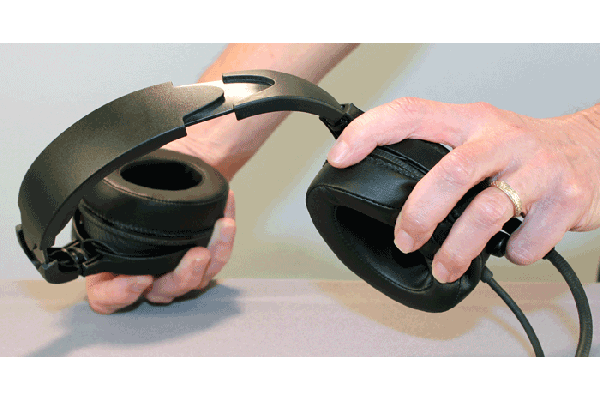
FlightCom Denali ANR vs David Clark H10-13.4: Which Aviation Headset Is Better?
A practical comparison of two very different GA headsets: FlightCom’s Denali ANR for active noise reduction versus David Clark’s proven H10-13.4 passive headset for durability, simplicity and flight-training use.
FlightCom Denali ANR vs David Clark H10-13.4: at a glance
These headsets solve the cockpit-noise problem in different ways. The Denali ANR combines passive isolation with active noise reduction, while the H10-13.4 relies on passive noise reduction and a proven mechanical design.
FlightCom Denali ANR
Best for: pilots who fly longer legs and want active noise reduction without moving into the highest premium price tier.
David Clark H10-13.4
Best for: students, instructors, renters and high-use environments where ruggedness and simplicity matter.
ANR or PNR?
Ask whether you want electronic low-frequency noise cancellation or a simple passive headset that works without batteries.
| Feature | FlightCom Denali ANR | David Clark H10-13.4 |
|---|---|---|
| Noise reduction | Active + passive noise reduction | Passive noise reduction |
| Battery | 2 × AA for ANR operation | None required |
| Bluetooth | Available on select configurations | No standard Bluetooth |
| Microphone | Noise-cancelling electret | M-7A noise-cancelling electret |
| Published passive NRR | Approximately 22 dB in current listing | Approximately 23 dB in current listing |
| Approx. weight | Approximately 14–15 oz in current listing | Approximately 19 oz in current listing |
| Best advantage | Active noise reduction and lower weight | Ruggedness, simplicity and proven training use |
Specifications and warranty terms can vary by exact configuration and can change. Verify the current manufacturer documentation and part number before purchase.
ANR vs passive noise reduction: what is the real difference?
The most important distinction is how each headset handles low-frequency cockpit noise.
Passive noise reduction (PNR) uses physical barriers, ear seals and acoustic materials to reduce incoming sound. The H10-13.4 has no electronic noise-cancellation system, so it requires no batteries and has fewer electronic components.
Active noise reduction (ANR) adds microphones and electronics that detect ambient noise and generate an opposing signal. This approach is particularly useful against continuous, low-frequency sounds such as engine and propeller drone.
Which is quieter in a piston cockpit?
The Denali ANR has the fundamental advantage for continuous low-frequency engine noise because it adds electronic cancellation to its passive isolation. The H10-13.4 remains a strong passive headset, particularly at higher frequencies, but it cannot electronically cancel low-frequency noise.
Noise-reduction verdict: FlightCom Denali ANR.
Comfort and weight for long flights
The current Jet Aviation Spare Parts comparison lists the Denali at approximately 14–15 ounces and the H10-13.4 at approximately 19 ounces. That difference can become noticeable during multi-hour flying. citeturn0search0
The H10-13.4’s heavier construction is part of its durability story. It is a headset built to tolerate repeated handling and high-use training environments, rather than to chase the lowest possible weight.
The Denali’s lower weight, combined with ANR, makes it attractive for pilots who routinely fly longer legs.
What about fit and glasses?
No specification can predict comfort for every pilot. Glasses, head shape, hair, ear-seal condition and clamping pressure all affect the real-world experience. If possible, wear the headset for enough time to identify pressure points before committing to a premium purchase.
Long-flight comfort verdict: FlightCom Denali ANR. Ruggedness-first comfort verdict: David Clark H10-13.4.
Durability and warranty: where David Clark stands out
The H10-13.4 has earned its reputation through decades of use in flight schools, training fleets and general aviation. Its passive design also eliminates ANR electronics and batteries as potential failure points.
The current Jet Aviation Spare Parts comparison describes the H10-13.4’s steel headband and long-running flight-school use as key advantages. citeturn0search0
That makes the H10-13.4 especially attractive for instructors, schools and pilots who are hard on equipment.
Why passive can be an advantage
- No batteries are required for normal operation.
- There is no ANR electronics system to troubleshoot.
- The headset remains usable without charging or battery replacement.
- Its mechanical simplicity is valuable in high-use environments.
Battery life and failure considerations
The Denali ANR requires two AA batteries for active noise reduction. That is a manageable trade-off for pilots who value ANR, but it creates another item to check before flight.
The H10-13.4 requires no batteries. This is one of its biggest practical advantages for training and backup use: there is no battery state to monitor and no ANR mode to fail.
What happens if the Denali batteries run down?
Confirm the current manufacturer’s operating instructions for your exact configuration. The current Jet Aviation Spare Parts comparison describes the Denali as continuing to function passively when ANR power is unavailable. citeturn0search0
Even with fail-safe operation, carrying spare AA batteries is sensible if you depend on ANR for long flights.
Bluetooth and connectivity
Bluetooth is where the Denali can offer a convenience advantage over a standard H10-13.4. Select Denali configurations provide Bluetooth for compatible devices and EFB audio, while the standard H10-13.4 does not include Bluetooth.
That can be useful for pilots who want to hear compatible navigation, traffic or EFB audio through the headset without adding another accessory.
Which headset should you choose?
You fly longer legs
- Engine noise causes fatigue.
- You want ANR without buying a top-tier premium headset.
- You regularly fly cross-country or IFR.
- You want Bluetooth on an applicable configuration.
- Lower headset weight matters.
You want a workhorse
- You are a student pilot or CFI.
- You fly many short training legs.
- You want no batteries.
- Durability is more important than ANR.
- You want a proven passive design.
You are buying your first serious headset
Think about how much you fly now, how much you expect to fly over the next five years, and whether cockpit fatigue or equipment durability is the bigger problem.
For student pilots
The H10-13.4 is an especially practical training headset because it is simple, rugged and does not require batteries. If you already know you will fly frequently after training and want ANR, the Denali can be a worthwhile step up.
For flight instructors
Instructors often place unusually high demands on equipment. A headset that is handled repeatedly, moved between aircraft and worn for many flights per day needs durability. The H10-13.4 is particularly well suited to this environment.
For private pilots
If your typical mission is a one-to-three-hour cross-country, the Denali’s ANR and lower weight can make the premium worthwhile. If you mostly fly short local trips, the H10-13.4 may deliver everything you need.
For IFR pilots
Long periods of concentration make cockpit fatigue more important. ANR can be valuable here, particularly when the aircraft has a strong continuous engine or propeller drone.
Price and long-term value
The current Jet Aviation Spare Parts article places the Denali around the $399 level and the H10-13.4 around $349, although prices can change. citeturn0search0
The important question is not simply which headset costs less. It is what you receive for the difference.
| If your priority is… | Better fit | Why |
|---|---|---|
| Lowest upfront cost | H10-13.4 | Lower listed price in the current comparison. |
| Active noise reduction | Denali ANR | Adds electronic cancellation of continuous cockpit noise. |
| No batteries | H10-13.4 | Purely passive operation. |
| Lower weight | Denali ANR | Current listing is several ounces lighter. |
| Bluetooth | Denali, select configurations | Useful for compatible EFB/device audio. |
| Training durability | H10-13.4 | Long-established rugged passive design. |
Final verdict: FlightCom Denali ANR vs David Clark H10-13.4
Best for noise reduction and longer flights: FlightCom Denali ANR. Its ANR system, lower listed weight and optional Bluetooth make it the more feature-rich choice for pilots who spend substantial time in the cockpit.
Best for durability and simplicity: David Clark H10-13.4. It remains a compelling passive headset for students, instructors, renters, backup use and anyone who wants a headset that does not depend on batteries or ANR electronics.
The choice is therefore less about finding a universal winner and more about deciding which problem you want your headset to solve: cockpit noise and fatigue or simplicity and long-term ruggedness.
Need help choosing an aviation headset?
Jet Aviation Spare Parts carries aviation headsets and pilot supplies. If you are unsure about the correct connector or configuration, send us your aircraft model and existing headset connection before ordering.
Also compare the premium options in our Lightspeed Zulu 3 vs Bose A30 guide and our Bose A30 vs David Clark comparison.
Frequently asked questions
Is the FlightCom Denali ANR better than the David Clark H10-13.4?
For active noise reduction and longer flights, the Denali ANR is the stronger choice because it adds electronic cancellation to passive isolation. The H10-13.4 is better suited to pilots who prioritize durability, simplicity, no-battery operation and training use.
Does the David Clark H10-13.4 use ANR?
No. The H10-13.4 is a passive noise-reduction headset. It does not require batteries for normal operation.
Does the FlightCom Denali ANR require batteries?
Yes. The ANR system uses two AA batteries. Verify the current operating instructions for the exact configuration you purchase.
Does the FlightCom Denali ANR have Bluetooth?
Bluetooth is available on select Denali configurations. Confirm the exact part number and configuration before ordering if Bluetooth is important to you.
Which is better for student pilots: Denali ANR or H10-13.4?
The H10-13.4 is a particularly practical training headset because it is rugged, passive and battery-free. The Denali makes more sense for a student who wants ANR from the beginning and expects to continue flying regularly after training.
Which headset is better for flight instructors?
The H10-13.4 is a strong choice for instructors because its passive design and rugged construction suit high-cycle training environments. Instructors who fly long legs or are especially sensitive to cockpit noise may prefer the Denali ANR.
Is the Denali quieter than the H10-13.4?
In a cockpit with significant continuous low-frequency engine noise, ANR gives the Denali an important advantage because the H10-13.4 can only reduce noise passively. Actual performance depends on aircraft noise, fit, ear seals and configuration.
Can the H10-13.4 still be used if batteries are unavailable?
Yes. It does not require batteries for normal operation because it is a passive headset.
How much does the H10-13.4 weigh?
The current Jet Aviation Spare Parts comparison lists the H10-13.4 at approximately 19 ounces. Exact weight can vary with accessories and configuration. citeturn0search0
Which headset should I buy for long cross-country flights?
For pilots who prioritize lower cockpit noise and reduced fatigue, the FlightCom Denali ANR is the stronger choice. The H10-13.4 remains a good option if you prefer a simple passive headset and place durability above ANR.
Product specifications, prices and warranty terms can change. Verify the manufacturer’s current documentation and exact part number before purchase. This article is buying guidance, not aircraft maintenance or installation advice.